
Franco: Thank you – in reading this my mind rebelled: I can see it thinking “I (as the mind) will never get the full precision” – and yet, I know I do, know the logic is 100% – but for my mind it is not permanent yet. It occasionally gets mildly infuriated by the apparent never ending Maya puzzle, which can never be fully solved by mind alone I think.
Sundari: Yes, that is the problem with the mind, it works on heuristics and looks for neat answers to overcome its frustration, forgetting that the ‘I’ getting mildly infuriated is not in the Maya puzzle, but the knower of it. Kind of like looking for your specs when you have them on!
Also, as you know only too well…:
Taking a stand in Awareness as Awareness sometimes turns out to be more than a little tricky because it is so subtle. The split mind (ego) watching itself has a slippery tendency to claim to be Awareness. But is it ‘unfiltered’ pure Awareness, or is it reflected awareness, and an ego-delusion? The ego is very good at co-opting any knowledge and presenting it as truth.
How to know, and how to deal with that? Taking a stand is done with the mind and can lead to a kind of self-hypnosis that makes the Jiva (person) think it is the Self without the full understanding of what it means to be the Self. Of course, based on logic alone, (is there an essential difference between one ray of the sun and the sun itself?) the jiva can claim its identity as the Self—but only when its knowledge of satya and mithya is firm, meaning, direct. Meaning, you never confuse reflected awareness with pure Awareness again.
And…
The practice “I am Awareness” does not give you the experience of Awareness or make you Awareness because you are Awareness. It removes ignorance by negating the idea “I am the conceptual jiva” i.e., ego identity/doer. When the conceptual jiva ego identity is negated, if the mind is sufficiently qualified, the jiva is known to be the Self – Jivatman. Mithya ‘becomes’ satya at this stage, and all is well from then on, even though life ‘in the world’ continues ‘as before’.
Franco: Recently I felt so “Vedantically tired” – not physically, not even in any explainable way but like the early moment in the Bhagavad Gita where Arjuna just can’t go on. Like my mind seeing itself going round in circles and “I” as the Jiva just could not figure it out. There was apparently as your mail so clearly defined a missing piece again, which I am so grateful for!
Sundari: I totally relate to this! We get “Vedanta-d out” quite regularly! It’s a good sign that you have or are cleaning out the teaching remnants. The idea is not to become perfectly proficient in Vedanta, but free of all limitations. Hanging on to the scripture other than for the pure pleasure it affords, would present another limitation.
My most recent art piece is of my favourite moment in the BG – and the most human. It is the moment when Arjuna realizes what is entailed and expected of him, his moment of terrible confusion and doubt. And Krishna is leading him on with such fierce and uncompromising clarity… I attached a pic. It is being fired at the moment, and the next stage will be glazing it.
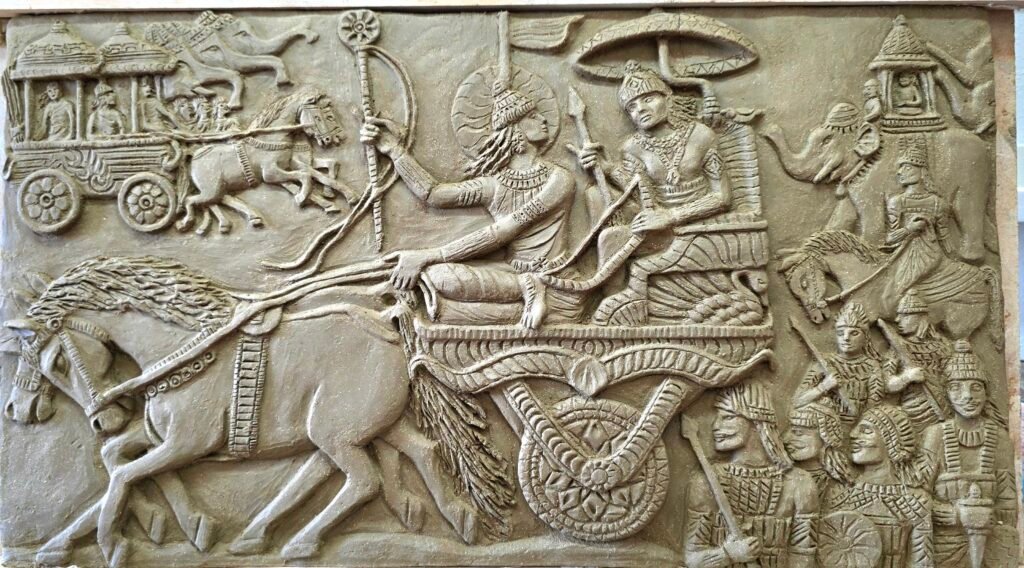
Franco: I also see now my attempts at Karma Yoga were still, deep down with a notion of doing “good, dharmic acts to be free” – in other words still subtly trying to gain something.
Sundari: This is a tough one to get, and crucial if karma yoga is to be effective. It’s the doing ‘to be free’ that is tricky. You are free and cannot do your way to it. So confusing for the poor ego.
Franco: It was on reading your reply that I saw both the misunderstanding and avoidance of the mind – I had misunderstood Karma Yoga: its purpose is to include Iswara in the picture, to recognise that any act done has no expectations on the results – as these are principally never up to me. Karma Yoga means repeatedly and to finally (at some point) help the mind and ego get this and calm the mind, tread lightly from thereon. We are not magicians, not able to influence one iota what happens even if “I” think I can. At best they are offerings and our thoughts, feelings and actions are given up as Isawara in us. For the first time in the Sunday Satsang I said something. James was so kind – he said after listening “but this is Karma Yoga!”
Sundari: Karma yoga, if practiced correctly, will lessen the pressure of the vasanas, ease the burden of the existential doer, and hopefully, eventually, completely negate both. It sounds so simple, and in essence, it is. Yet it isn’t simple because though life is nothing but karma in terms of change and movement, there are two types of karma: impersonal – meaning just what happens, and personal – meaning, psychological. All karma is actually neutral.
Humans give what happens, karma, meaning by identifying as the doer and liking or disliking results. This is why there is no karma for any other living creature; things happen to them and in them. No other living creature has thoughts that they are the doer, or that things should/shouldn’t happen in any particular way, even when life brings suffering. Only human doers suffer psychologically. And only we need to bring Isvara into the equation – which is, karma yoga.
Franco: Someone else later reflected in response that she had realised that there is no freedom if it’s just the Jiva and Vedanta teachings going round and round (Jiva circles, Jiva puppies chasing tails one could say) – trying to be free without including God in the picture for real. For spiritually inclined types who often have rejected dualistic religions with good reason and have an unexplainable impulse (from the Self which they are) it is like letting go of a trapeze and being very uncomfortable in mid-air, without an ego “safety net” for a long time, maybe years, to only then catch on to apparently the same but very different trapeze on the other side, where “we” admit God is real but crucially non-dual.
Sundari: Too true. There is no freedom from limitation, no escape from mithya without understanding Isvara and jiva, how and why they are the same but different. It is a tall order for the ego to get on board with the idea; but for the full transference of the ego identity to move to the Self it is essential. This is where all the teaching of Vedanta takes place.
Franco: I can see this in my own case for decades, having bounced off classic religion and falling into various modes of spirituality (which rejected or at best ignored “God”) before meeting Vedanta and James. Even at this first meeting the knowledge of knowing that it must be Vedanta was primarily the same tiredness outside having gone a long way for apparently nothing, with a clear simple clarity inside, even if (at the time) it was a maelstrom of ridiculousness in “my life” I seemed so bound to.
Sundari: I think the majority of inquirers who find Vedanta have been through this, James being a rare notable exception. It is a shame that religion gets so much of God wrong. But, it plays an important role for many. Life is better with God, however you see relate to it, deity/person or essence/impersonal.
Franco: While Maya is unexplainable and very tenacious as you point out, there must also then be an anti-Maya (?), a grace unexplainably pushing us relentlessly to knowledge at some point, inevitably, bouncing off Iswara’s lessons which, without Vedanta seem horribly random and where I continually mistook either “good” or “bad” results that it was because of “me”. It wasn’t, it never was and only dimly perceived that I was probably a puppy being thoroughly wagged by its own vasanas which can only be reduced with Karma Yoga.
Sundari: Well put! I like the anti-Maya reference, like the hypothesized antimatter particles. Yes, it is like that in mithya. Everything is dependent and contains not only its opposite, but more importantly, its true (uninvolved but intrinsic) essence. It’s the latter that is overlooked when Maya is operational. It is so interesting to observe how blind Maya can make even the most ‘brilliant’ minds throughout time. When nondual vision is firm, though it will never make you omniscient (thank God, who would want that!), you are essentially smarter than anyone (who is identified with being anyone) could ever be.
Franco: The mind “fully accepting nonduality” as you say I see is rooted in the knowing I am the Self and at the same time knowing everything else (in other words, Iswara) is also – these two are immutable.
Sundari: It’s not that the mind ‘fully accepts nonduality’. If Self-knowledge obtains, the mind has a new operational system, nonduality as opposed to duality. Like cleaning your car windscreen of many layers of dust and grime, the mind ‘sees’ not only what was always there, but clearly. Progressively, as the mirror of the mind is cleaned by Self-knowledge. Sometimes it is dust on a mirror, easy to clean; or it can be grime which is harder. But it is the ‘foetus’ in the womb kind of ignorance that takes a lot more ‘effort’.
Franco: My mind cannot reflect the Self without this knowledge being fairly permanent, regularly.
Sundari: Well, it’s true that the mind cannot know or reflect anything without the presence or light of Consciousness shining on it. Your mind is an object known to you, the Self. It is just a lens through which ‘you’ either as the Self ‘see’ your true essence as the ‘seer’ who sees only itself, or as the ego who thinks it is other than what it sees.
Franco: It seems now that giving up the ego idea that it can “have its cake and eat it”, i.e. solve the Maya puzzle on its own (be an enlightened person who can thoroughly explain why to themselves) is illogical.
Sundari: Yep. That would be the ego talking …but. You can have your cake and eat it if you know you are the cake…
Franco: Fully considering, assimilating repeatedly, the precision of the entirety, via Karma Yoga to remind the Jiva of the truth “I” find myself in, this is something we can “do”.
Sundari: This is a doing that unlike any other doing undertaken by the limited doer, forgoes the idea of doership, and thus, can produce a limitless result = nondual vision.
Franco: There was an odd piece from Huxley which seems appropriate, which he wrote towards the end of his life (after Lord knows “trying” so hard!) – I am not a fan particularly but there were two lines he mentions in this piece which stood out “quicksands all about” (Rajas and Tamas) and “completely unencumbered” (the Self).
Sundari: Yes, quicksand is a good analogy for rajas and tamas, as is ‘completely unencumbered’ for the Self. Sadly I am quite sure that Huxley had no such true insight, and though he could use the term ‘completely unencumbered’, would never have known its true meaning. I guess the best he could hope for was to tread lightly, as he says he learned. You will have an easier life if you do, but it will not prevent you from getting blown up in the Maya field because there is still someone identified with the treader.
Much love to you too, dear friend
Sundari