
Dear Leila
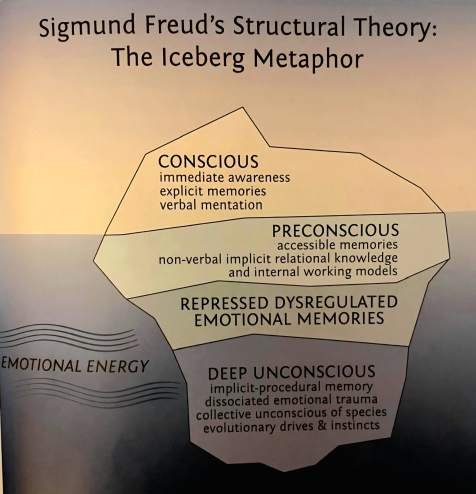
Thank you for sending this graph. I find Freud’s analytical model interesting and quite accurate in terms of the subtleties involved in Isvara’s psychological order. Of course, he had no idea of this as his means of knowledge was inference and the senses, sourced purely within mithya (duality) and centered on the jiva or person. He had no knowledge of the gunas, Isvara or Maya, and certainly, not of the nondual Self or Consciousness – the essence of, and common identity between, Isvara, the Universal Being, and the Jiva, the personal being.
Nonetheless, basically, Freud’s model covers the jiva or microcosmic universal person (mind) or Subtle body, and the Macrocosmic Universal impersonal being, Isvara or Causal Body. As we know, both make up the apparent reality, and thus, neither are ‘real’ in terms of Vedanta’s definition, meaning, always present and unchanging. That only applies to the witness of both, Pure Nondual Consciousness.
Here is my translation of Freud’s Iceberg Analysis, in terms of Vedantic thinking:
The field or emotional energy or ‘ocean’ the iceberg is floating in is Maya. Or more specially, the effects of Maya – mithya, the hypnosis of duality.
The Lowest Two Levels Cover System 1 – Isvara – Impersonal Being or Causal Body
1. The lowest level of the iceberg: The repository of all unmanifest universal evolutionary tendencies/patterns/vasanas. Pure tamas, total ignorance. Sattva and rajas are present but not active. Also called the Macrocosmic Unconscious.
2. Second level of iceberg: Still predominantly tamas, but some sattva and rajas activated allows for the progression (rajas) away from total ignorance (tamas) towards manifestation of the personal unconscious.
The Third and Fourth Level cover System 2 – Jiva- Personal Being or Subtle Body
3. Third level: Lowest level of Subtle Body, personal or microcosmic unconscious. A little more sattva and rajas active, though deep tamas still prevails. At best, dimly known content, but inaccessible to personal awareness for the most part. It is hidden and therefore, effectively completely unknown. But at this stage, the possibility of knowing becomes available.
4. Fourth level: Personal or reflected consciousness: All three gunas are active. Sattva is actually the nature of the mind when rajas and tamas are in balance with it, which allows for perception, that which is known and accessible to be known. How clear our perception is depends on how much rajas and tamas are present covering sattva. This is what will determine how strong our personal filters are (conditioning/vasanas/likes and dislikes).
Until we have developed some objectivity about how our unconscious mental/emotional subjective reality, level three still holds sway. But even when we have developed some objectivity, there will be no real freedom from and for the person until and unless the qualifications for self-inquiry develop, satya – mithya discrimination and the nondual teachings assimilate, and are put into practice. I.e., Self-knowledge obtains.
This essentially is a process of retraining the mind to change its habitual ingrained dualistic thinking to nondual thinking, which is very subtle and difficult. It takes not only qualifications and being properly taught by a qualified teacher, but constant, repeated application of the nondual teachings until Self-knowledge obtains and actualizes.
As you know, all four levels create the lived experience of the jiva. Though level one and two (system 1) are unknown and inaccessible to conscious (reflected) awareness, they very powerful and influence the mind (system 2) in ways too numerous to mention. In fact, as they are behind the jiva’s vasana load or likes and dislikes, they are in the driver’s seat until and unless they become known and understood, and the mental emotional patterns associated with them are at least upgraded, if not negated.
In psychological parlance, this is called becoming a well-adjusted ‘normal’ or ‘healthy’ human being. The health and happiness of the person depend on this, but there is no ultimate solution to existential suffering unless ignorance of our true nature is removed. Even as a more adjusted human being, you will still be trapped in duality and dependent on objects for your happiness/peace of mind. In fact, to my knowledge, Freud concluded that true mental health was not possible as an ideal state, and being ‘functionally depressed’ was the fate of most people. He was not far off when you understand how duality works. Pity he did not have access to the nondual teachings of Vedanta!
As I said in my talk last Sunday, for any true and lasting change to take place on level three and four, the personal level, a change must first take place in level one and two, the impersonal level. This is like David going up against Goliath, without Self-knowledge. Even with it is a battle. You know all too well how hard if not impossible it is for most people to change their behaviour once it is ingrained, even when it is known how destructive it is. Sadly, ignorance is highly resistant to change.
While the psychological model can help to some degree to help some people manage a modicum of peace, it is not up to the task of removing ignorance and the cause of suffering, you know this all too well. It must be very frustrating having the knowledge you have and being unable to help people who come to you, unless they are open to real growth. As a psychologist, especially since the ‘psychological industry’ is geared to a conformist and very limited approach to mental health, your hands are pretty much tied.
Although basic karma yoga and guna knowledge can be taught even without qualifications for self-inquiry, this is still a huge leap for most people. You cannot help anyone escape from the prison of ignorance if they are unqualified for self-inquiry, without a valid means of knowledge such as the nondual teachings of Vedanta. How you blend the two for the average person working ‘within the system’ is therefore, very difficult, given that qualifications are required and you cannot deviate much from the straitjacket of what is deemed correct behaviour from a professional therapist. A bit depressing, sorry!
I hope this helps
Much love
Sundari
ShiningWorld.com