
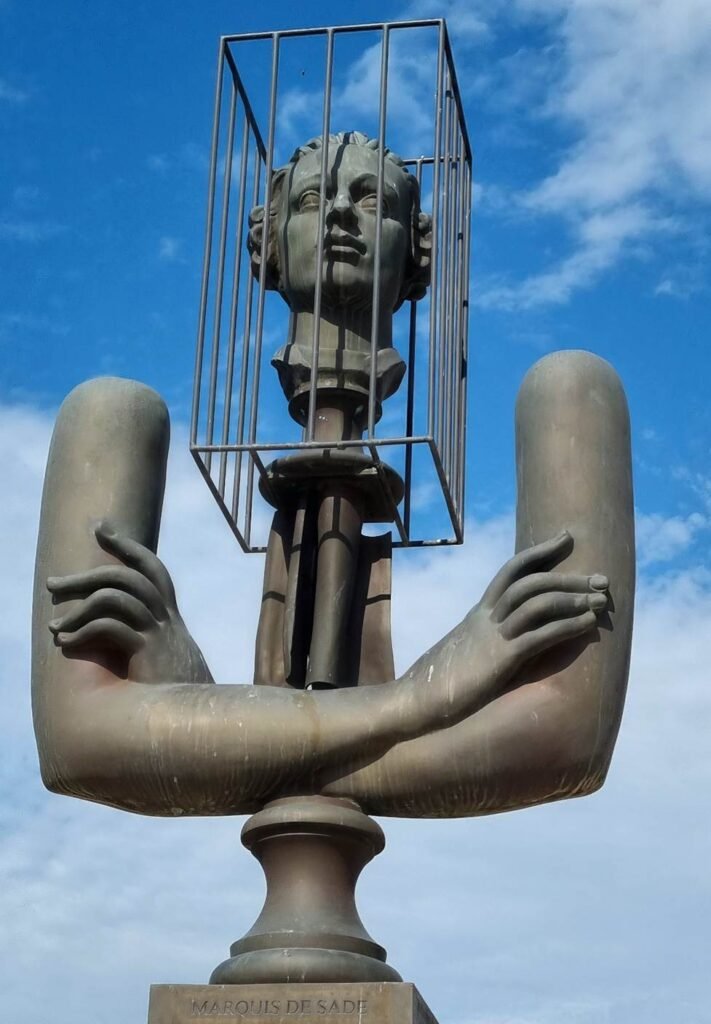
Take a very good look at this image, as it is symbolically significant. It is a photo I took of a sculpture situated outside the restored castle of the infamous Marquis de Sade, at the top of a beautiful village in Provence, near the house of a good friend of ours. It is a larger than life, striking statue by Russian sculptor Alexandre Bourganov, which depicts only the head and unattached torso and arms of the Marquis de Sade. The Marquis lived in France in the 19th century, he was a nobleman, political activist and libertine, known for his outrageous views on love, and his deviant sexual practices. Among other things, he allegedly imprisoned young girls in the castle and sexually abused them. He was not a noble or admirable character, that is for certain.
Most people looking at this sculpture will admire it, relating to the energy of defiance and resistance to convention it portrays. The eyes particularly stare out, unrepentant. Maybe they will think how awful the Marquis must have been, but most likely will not identify with him. Yet what is so interesting about the sculpture is how it symbolizes what is true for everyone – namely, that we are all imprisoned in our minds, our subjective realities.
The Marquis de Sade is shown here with his head imprisoned in a cage, with crossed arms that are free. The important part of the sculpture symbolically is not only that the head is in a cage, but it is unattached to the torso and arms – the doer. And so it is for all of us. We are all born free as the unborn Self. But as human beings, thanks to the gift and the curse of self-reflectivity, we are the only living creatures that are trapped in the cage of our thoughts, our subjective reality. No other creature suffers the bondage of doership. We are all alone ‘in’ there, our minds, with our thoughts and feelings, while the doer, or the one who acts the body, is seemingly ‘outside’ the head. But it is not outside the head, and very much under its command.
We remain in that subjective cage until and unless we have the great good fortune of finding the key that will open the door to freedom from bondage – the limitation of the belief that we are a person. This is the sole purpose for self-inquiry. What we are all looking for, what everyone is looking for whether they know it or not, is freedom from and for the mind. The sculpture is a fitting universal symbol for how ignorance and bondage works – and how everything depends on the mind.
No matter whether we approach freedom through religion, philosophy, psychology, or Vedanta, there is no way to freedom from or for the mind without understanding our psychology. So, as lovely as it is to read from the nondual scripture and get high on them, all we ever address as teachers of Vedanta, is your psychology – the mind. That is the nitty gritty of it all. This is what all the scriptures are pointing to.
Freedom and Free Speech
Ramji’s talk a few Sunday’s ago was essentially about the dharma of speech, that powerful instrument Isvara has bestowed upon us. ‘Free’ speech has always been a contentious topic, hotly defended and proclaimed as essential to freedom and a democratic society. But no matter how much you believe that speech should be free, which means anyone is allowed to say and do whatever they think is true according to their value system, we cannot get away from the issue of dharma. It is not dharmic to injure ourselves or others – not in thought, word or deed. And the word, what we say to ourselves or others, is a very powerful tool indeed, both externally and internally. What beauty, healing, and devastation it can bring forth.
If external speech causes injury to others, yet we think it is in alignment with our values, is it dharmic? Usually, it is not. Think about the idea of infallibility by the Catholic Church, that they had the last or only word on truth, and the terrible scourge of the inquisition that brought about. Or all the wars in God’s name, the horrors and genocides perpetrated on others in the name of freedom, or justice. Sometimes war is necessary and injury to others is unavoidable, this is true. Consider Arjuna who had to take up battle against his own kin to uphold dharma. But it is a very tricky area to navigate, with many slippery slopes.
It is said the pen is mightier than the sword. Well, our speech can be too. Speech management is one of the most difficult qualifications we all need to learn. But what about our internal speech, how dharmic is that? What is your internal voice constantly whispering in your ear? What cage is your mind trapped in? The most intimate conversations we have, the ones that no-one ever shares with us or knows the content of, are our internal dialogues. How we talk to ourselves, the things we tell ourselves repetitively and predictably, whether true or not. Most often, negative and not true. Expedient maybe. Resistant, defensive and avoidant, very likely. We can injure ourselves as badly with our internal speech as we do others with our external speech.
Philosophers and spiritual teachers through the ages talk about this because ‘in your head’ is where you, as a “you” really live and experience, just like the Marquis de Sade, imprisoned in his head, in bondage to his vasanas. There is nowhere ‘else’ that you experience anything but in your mind. The quality of your life is as good as the quality of your internal dialogue – your thinking, and what feelings you allow to take up residence there.
Remember this: nothing you think, feel or say to yourself is hidden from Isvara, or the Self. Therefore, your most important relationship is your relationship with God. Which brings up the all-important question: what is the quality of your relationship with your own mind, and thus, with God? Have you ever thought of your mind in that way? How at one with Isvara, how noble is your mind, how true are you to the values and the dharma of right living, there? Because if not there, where?
Bondage and The Problem of Resistance
In tonight’s talk I want to focus on arjavam – the beautiful Sanskrit word which means straightforwardness, sincerity, integrity, non-hypocrisy. In other words, the alignment of thought, word and deed. It is the essence of non-injury, and of self-inquiry, and how our speech, both internal and external, are integral to living according to dharmic values.
If despite the values you claim to have, or how ‘spiritual’ you think you are and how much you believe you follow dharma on the ‘outside’? If on the inside your internal dialogue and your thinking/feeling is not congruent with your highest values, and you resist what is, or following through on what you know is required of you according to life, and especially the dharma of an inquirer, you will feel like a fraud, an imposter. Because you are one.
As inquirers, it is that internal dialogue and mental/emotional agitation which brought you to Vedanta. You were so tired of the kind of mind you were (and maybe still are) living with. You want freedom from your thoughts and feelings. You want answers to life’s most intractable problems to resolve your internal battles. If you were fortunate, you already knew it had to be you as the ‘you’ you thought you were that was/is the biggest problem. And you had/have what it takes to face that. If this is true, the journey to freedom from bondage has begun, or is well on the way. It is not an easy trip, as most of you are well aware.
Though true inquirers are few in number, if you ‘found’ Vedanta, you certainly were blessed to find yourself at the door of nondual truth. The greatest grace possible is to find Vedanta and a qualified teacher. But, did you read what was written above the door of nondual truth? Maybe you didn’t see it or didn’t realize there was a doorway you had to cross. It’s an invisible door, but there was a threshold you crossed. And what is said above the entrance of the invisible doorway was this: All who enter here, beware.
If you cross this threshold, you have to surrender your passport (mind) to a completely different way of thinking – one that will demand no less than everything of you and from you. You cannot hang onto it. And you won’t get your mind back in the same way you thought you had it before – as ‘yours’. Did you realize what you were entering into? It’s a bit like the gate of Dante’s hell, which said ‘abandon all hope, all ye who enter here’. Except it is not hope that you must abandon, but the hell and imprisonment we create in our own mind when we are identified with it, run by compulsive thoughts and emotions, binding likes and dislikes, doership, resist what is, seek solutions in and depend on the world of objects. We do not live according to dharma.
It may be hard but, if Vedanta has come to you, the chances are good that you have suffered enough and have developed at least some of the qualifications required to submit to self-inquiry, and to being properly taught. The chances are also good that you have searched extensively for answers everywhere else, and you have realized there aren’t any. Not if you are serious about self-inquiry and freedom from limitation.
This is preaching to the converted as many of you who attend our satsangs are well-established in Self-knowledge. But all the same, it is our duty as teacher of Vedanta to constantly remind everyone that while the infallible means of knowledge Vedanta provides requires a reconsideration of your true identity beyond that of the merely mortal, meaning the nondual Self, it does not exclude the mortal. We cannot ignore the mortal being because that is where all ‘the work’ of self-inquiry takes place.
It would be lovely if it were enough to just be told you have been mistaken about your identity your entire life, and to be shown why that is not who you are should suffice as the end of the story. We do tell you that, right up front, and all the time. But, the more tedious part is that we must also repeatedly tell you that to be firm in Self-knowledge involves a reconsideration of who you are as a mortal being. What forces make up your psychology and the field of life you interact with, and how you live as a jiva in this world. You just cannot escape that…Oh bother!
Especially the last part. Vedanta, Isvara, wants your mind, that identity who is the egoic doer, and the problem, to submit. It has to if freedom is truly important to you. So a good question to ask yourself often is, am I really after freedom? Or am I satisfied with just window dressing, talking about nonduality, and thank you very much, don’t you dare come after my ego! That is off bounds. How much of a stronghold of resistance do you, as an ego, hide behind? Is your mantra, ‘I am the Self, that is all I need to know.’?
Fair and true enough. But knowing your true identity as the nondual unchanging ever present Self does not mean you as a mortal being stop living in this world. It just means that you know that the world is in you, that neither the mortal being who is born and dies, nor the ever-changing field it experiences in, are real. Real being only that which is always present and cannot be altered or changed.
But, for Self-knowledge to actualize means that the nondual teachings need to be lived as a mortal being who knows that they are immortal. After all, moksa is for the jiva, right? You have heard this countless times. Does it sink in, what that entails? There are no shortcuts to freedom. Being the Self does not mean that you get a pass to hang onto your egoic doer, with all its resistance and clinging. It has to go, sorry! ‘Has to go’ means the ego has to be dismantled, not destroyed, please note.
All well and good, if that is the case, for you. You don’t need moksa as the Self, life is a picnic from here on in. Except, for most, it’s not, right? As much as you now have all the knowledge of who you are and are not, what’s what and who’s who, how to respond to the field of experience with karma yoga, guna yoga and bhakti yoga, there is still a problem. The bliss of Self-knowledge is not always available. It comes and goes.
That problem can have many causes, from lack of certain qualifications, to lack of motivation, to lack of application of the teachings, or to ego ‘enlightenment’ and other subtle doership issues. All of those reasons are problematic, especially when the true practice of karma yoga is not understood or applied. More on this further on, as this is a big sticking point for many. But the problem usually boils down to one thing: there are remaining binding likes and dislikes – which of course, means there is still a doer. Oh no, no that again!
Doership, likes and dislikes. We can’t seem to get away from those somewhat inadequate, pesky terms. Easier to lump them under a foreign sounding word which seems to make our likes and dislikes more ‘not me’, such as the Sanskrit ‘vasanas’. What’s a vasana anyway? Why are they such a big deal? I don’t have vasanas as the Self. Well, are you firm in that knowledge? If you still have binding likes and dislikes, you are still in that mental prison as depicted in my photo of the Marquis de Sade. We like to use the term likes and dislikes because it makes vasanas more discernible – more obvious. Though they may seem innocent enough, they are what keep you bound to the doer, the egoic entity.
Most of us like our likes and dislikes because they appear to give us a sense of identity, and of gaining something. But they cause suffering because binding likes and dislikes means you are resisting the way things are, meaning Isvara. And it is resistance, dear friends, which is behind all our problems. The jiva/egoic/doer entity can be defined as the one who resists what is and who thus worries thanks to its likes and dislikes. The ‘wanter’ wants what it wants, worrying constantly about getting and keeping.
The biggest problem with wanters is that they are not inclined to give up wanting, and therefore, they are not inclined to do what it takes to look at their ‘stuff’. It might mean they are forced to give up wanting. No way! Many inquirers lose interest in Vedanta when they realize it’s not much fun to look at your stuff, and worse, Vedanta is after your ego! Forget about it.
Humans are inclined to be very lazy and hate change; Isvara seems to make us like that. Who wants to work so hard to improve your character when it’s not even real? True enough. But you get to live with that then, and so does everyone else. You can talk all you like about the nondual scripture, but freedom is just a word you throw around in your head. You don’t really believe it, and certainly, do not live it, though you may fool yourself that you do. You are like the Marquis de Sade, in prison in your head.
Resistance and the Rehabilitation of Your Word
Apart from the fact that it’s hard and not much fun to look at yourself and change ingrained patterns of behaviour, or binding likes and dislikes, there is another factor that is usually involved. And that is low or lost self-respect due to the quality of our internal dialogue, and the resistance that has eroded the trust you have in yourself that you will keep your word, and follow through.
Not only to others, though that is certainly important. But much more important is keeping your word to yourself. If you habitually fail to keep your word to yourself, never following through on things you say you will do, you will not have healthy self-esteem or self-respect, period. You will often feel like a fraud because you are not following dharma. Worse, this will make it more difficult to make lifestyle choices and changes that support the dharma of an inquirer. You will live perpetually in potential, not in actual. Always on the way but never arriving.
The dharma of an inquirer is to apply the teachings to every aspect of your life. No fine print. Freedom requires everything from you. Did you not get that when you crossed the threshold of Vedanta, into a new world, one that looks the same but is entirely different from the one you previously inhabited? You need the right passport to live here. Immigration control is very stringent, and Isvara does not make exceptions.
In this world, if your lifestyle, values and your likes and dislikes are not in harmony with dharma, which is to say with Isvara, you pay a price. Isvara will eject you from the world of freedom from limitation because you do not belong there. Or you , as the egoic doer, will reject it. You cannot hang on to bondage and claim to want freedom from it. For this reason, I deliberately used the word ‘rehabilitate’ in the title of this talk. The word to ‘rehabilitate’ means to restore health, wellness, freedom, or anything that has been damaged or taken away from us.
So, here again, when we talk about free speech and the effects of speech on us and our environment, we must ask ourselves, how do I habitually talk to myself? How free is my internal speech? Do you often have to take the walk of shame because of the disconnect between the ideas you throw in your head, your values, and how you do or don’t act on them?
Now here us the crux of the matter, especially if you are a committed inquirer. If you constantly resist following through and do not keep your word to yourself and to your values, you will need to rehabilitate that first, before you succeed at making any lasting changes. Big one, and no way around it. You need the right relationship with your mind because the main aim of an inquirer is peace of mind. No peace, and no freedom, is possible if you do not keep your word to yourself.
The good news is that we all have the capacity to keep our word, and if we have lost that ability, we can restore it. It’s like any muscle – we can strengthen it with proper training and commitment. Why is that important? Because to get purchase on surrendering your likes and dislikes requires making a firm sankalpa – a commitment to making the change. It’s not enough to get high on the idea that you are the Self, if that does not translate into how you live your life, even though it’s true. And that sankalpa will only have legs if you have faith in your word to see it through. If faith in your word is not there, you are dead in the water, so to speak. Up the creek without a paddle. Simply put: self-inquiry isn’t and won’t, work.
Sadly many inquirers reach an assimilation and application setpoint beyond which they are not willing to pursue or push, and it’s usually because of this. There may be lots of fire for the teachings and the ‘truth’, and much pleasure in reading the scripture. But there is not enough fire to address the shortcomings of the jiva. We see this all the time with inquirers, unfortunately. Ignorance is very powerful.
Failing Makes Us Afraid of Failing
A self-perpetuating loop is in play. If the reason for you not being able to put into practice the teachings comes down to lack of belief in your own word to yourself, and you often fail at doing so, then you will be afraid of failing. As humans, we hate doing things we fail at because it makes us feel bad. It goes without saying that nobody enjoys feeling bad – and we feel bad when we break dharma.
So, we steer away from what we failed at whenever we can, instinctively and subconsciously. Tamas in the form of resistance and procrastination is usually the cause, and it goes hand in hand with denial. Fear of failing has become a binding vasana, and we are very good at hiding that fact from ourselves.
Think about anything you may have decided is good for you to start – let’s just take something seemingly ‘unspiritual’, like eating healthy, or going to the gym. You really, really want to do this; you know you must, that your health is important to your peace of mind, and thus impacts your spiritual life. But, somehow, you never do. You are a failure. And that failure means you will keep avoiding what you fail at because it feels bad to fail. It’s a closed loop.
How do we rehabilitate our own word, and become a disciple unto ourselves, effortlessly doing what is good for us, even if that involves ‘effort’ on our part, which it will, at first? Well, of course karma yoga is the way of the inquirer and the only way to cancel the doer. But the problem here is that when the fear of failure vasana is in place, it can be a smokescreen for karma yoga. And karma yoga does not work when we use it to avoid or resist doing what we must, which often happens.
Also, many inquirers do not actually understand what karma yoga entails, though they think they do. There is the notion that karma yoga is skill in action, but it is not. There are many people who are very skillful at avoiding and resisting right action, in the name of karma yoga. This is not karma yoga; this is denial. Or you may be very skilled at ‘doing’ the right thing and calling it karma yoga and surrender, but it is far from it. Just because you are skilled at something does not mean you are taking appropriate action in accordance with dharma, and surrendering the results.
If karma yoga is purely skill in action then even a successful hitman is a karma yogi. What is karma yoga, then? Karma yoga is the right attitude, which is that the results of action are not up to you, and it is right action which is in harmony with dharma, both personal and universal. Karma yoga is renunciation of anxiety for any result, but it is not denial.
If you are anxious when you act, how skillful will you be? Conversely, if you are fooling yourself that you feel chilled but what you are actually doing is renouncing doing what you should be doing, how skillful, or how honest, are you? Therefore, if you put karma yoga in practice correctly, skill in action is an effect and one of the benefits of karma yoga. But on its own, skill in action is not karma yoga.
You just can’t fool Isvara, the truth. It always has its eye on you. It is easy to give lip service to changing your behavior, or justifying it when you don’t. You hear yourself say things like, ‘oh well, that’s just how the jiva is made, and I am not the jiva, so who cares? I surrender it all to Isvara’. Ha ha. Except, resistance and avoidance is not surrender.
Simply doing something well is not surrender. In all cases the doer is active, and you are simply banking your likes and dislikes. You are not negating them. Moreover, you do care and there is a price to pay in loss of peace of mind because you are not following dharma and limiting yourself. You are not free of bondage. Isvara does not care, one way or the other, and will deliver the karma.
There is no blame or any real right or wrong here. It all comes down to how free of the jiva you want to be, and how free as a jiva you want to live. You can neglect your health, your home, your relationships, anything. You won’t stop being the Self. It is true that none of it matters and you don’t have to do anything because you are the Self, even though as an inquirer it is your duty to follow the teachings to the letter. It is a huge step in the right direction to know you are the Self, even if you don’t live free of the jiva and as a jiva. But wouldn’t that actually be a lot more fun? I can assure you that it is.
How Resistance Works in the Stages of Self-inquiry:
Resistance to right action and not following through on your word is a big issue when you move from one stage of self-inquiry to another. Here is how it works with karma yoga:
1. From Samsara to Karma Yoga – You start hearing the nondual teachings, and the ego strongly resists looking at its likes and dislikes; it can and usually does use denial as a smokescreen for karma yoga. Here there is limited arjanam, straight-forwardness, sincerity, and integrity. You are not in alignment in thought, word and deed because you are not living up to your internal and external dharmic values. If you are lucky, you will not feel good about yourself, and feel like a hypocrite. If you feel good about yourself, you are most likely not qualified to proceed further with self-inquiry.
2. From Karma Yoga to Meditation – Hopefully some assimilation and application of the teachings in the line of genuine karma yoga is in play. But again, the ego can fool the mind that is applying the law of karma and dharma, under the guise of ‘being spiritual’, but it is just avoidance. The ego is alive and well, and you may be in the first stages of catching a good dose of ES – enlightenment sickness
3. From Meditation to Jnana Yoga (Standing in Awareness): If assimilation has taken place and Self-realization has obtained, there will be congruency between your inner and outer mind space. You will be applying the teachings correctly to your life as a jiva, particularly karma yoga. The dualistic mind is under new management – Self-knowledge. If not, the ego has survived moksa and is in some ways, protected by the notion that ‘it’s not me, so why bother?’ There may even be the idea that you are special or somehow have special powers because you are the Self. This is the Advaita shuffle, or enlightenment sickness in full force.
4. From Jnana Yoga to No-sum or All Sum Reality (Standing as Awareness): This is full surrender of the ego to Isvara, all resistance is gone, it’s the end of doership. Likes and dislikes have no power to imprison the mind. you are free of the jiva program, and free as a jiva. Karma yoga is not something you need to think about but the natural response to the field. Here Zero Sum becomes All Sum, because though you as the Self are free of the jiva and the world, you also know that everything is you though you are not it. There may be some remnants of the teaching remaining, but they do not hold you back, and you no longer need teaching. This is Moksa.
The Steps to Rehabilitate Your Word
If you are stuck at any of the levels described above and have the problem of never keeping your word to yourself, justifying it and feeling bad in an endlessly predictable loop, there are some steps you can and need to take, assuming you want freedom.
1. Admit It. See the problem and admit that you are it. It’s never anyone or anything else. Ask yourself: Why is there resistance to follow through – who or what is resisting what? Each level of karma yoga described above provides a benefit in so far as it releases you from limitation; it takes you from samsari to Self-actualized, if nonduality truly assimilates.
If nothing else sticks from my talk tonight, listen up – here is the main issue with all stages of self-inquiry, so take note: the problem with ignorance is that a setpoint accompanies each level. Why? Because you as an ego get comfortable there and are highly resistant to change. It’s hard work! Comfort and convenience is the enemy of freedom when the ego is in charge.
2. Decide On One Issue. Ok, so you are clear where the problem lies. Now, decide to tackle one issue at a time.Don’t set yourself up for failure by going the tamasic route and beating yourself up, or stepping on the rajasic gas pedal trying to change everything at once. Start small. Go for the low hanging fruit first. A like or dislike, of course, one that you know you need to make changes in, and you repeatedly avoid or put off doing so.
3. Use Your Will Power. We do have relative will power and we can use it to attract good karma by working in harmony with our higher values, our dharma as an inquirer, and in harmony with Isvara, or universal dharma. In this way, we do not resist what is, we add water to the river of life as a contributor, not an extractor. You add value by being true to your values and acting in accordance with dharma.
4. Put The Three Laws of Karma to Work:
a.The Law of Right Action
The Law of Right Action or Karma states that all actions have consequences, and we are not in control of those consequences, only how we relate to them. As you reap, so you sow. You need to take the appropriate action in surrender to Isvara – as a doer who does not own doership.
b. The Law of Dharma – Right Attitude/Values
Isvara, the Field, is impersonal, and runs on natural impersonal laws or dharmas. It must, to function at all. The universal laws are dharmas or laws that apply to everyone. We do have agency to respond appropriately to what life brings our way when we understand these natural laws. The law of dharma, right action, on the universal and personal level states that we must respond appropriately to what life asks of us on both universal and personal levels, or we suffer. This means we always act in accordance with the highest value – non-injury in thought, word and deed – which includes the avoidance of the right deeds.
c. The Law of Attraction – Grace.
Thanks to the Law of Attraction and Grace operating in the Field, the jiva can maximize getting what it wants when it understands the law of karma and dharma. Here free will can be put to good use. The good news is that even though from the big picture point of view, meaning the Causal or Meta reality, everything is preordained, it is still true that grace is earned, that is the natural law of attraction. The squeaky wheel gets the grease, that kind of thing. Isvara has no choice but to respond to us in like kind because Isvara is the Self and so are we. We don’t try to game Isvara, but we manage the gunas to maximize sattva and attract grace.
4. Make a sankalpa. The sankalpa of keeping your word is simply this: I act on the basis of the truth i.e. I am free. This means I will always keep my word, to myself and everyone else, because there is only me. Why would I limit myself by doing otherwise? I am free to act or not act, but I never avoid or put off right action because I am surrendered to Isvara and I protect my peace of mind at all costs. No excuses!
Make a decision to keep your word on just one small step. Just one small step. For instance, say you want to start going to the gym but are terrified of even setting foot in a gym. Set yourself the goal of just walking in and out. Next time, set the goal of going in and having a health drink and sitting down, then walk out. Next time, just 2 minutes on a treadmill. And so on. If you achieve these small seemingly lesser goals, it’s not a failure. You did what you said you would do. Remember what you are after is restoring faith in your word – so that you know without a doubt that if you say you will do something, that is a given. You will do it. That is your goal.
You can extrapolate the example I have given above to absolutely any issue, whether it is related to something physical, psychological or spiritual. In the end, it all comes down to psychology and retraining the brain. Don’t criticize yourself if you fail, but don’t be too easy on your (not) self either. The mind is a lazy beast and it will quickly revert to bad habits, given the chance. It is always looking for the easy way out or around. A healthy contempt for that is not a bad thing. Eternal vigilance is the price of freedom.
Remember at all times that the goal is not to be a perfect human being living a perfect life, but a happy, peaceful human who always follows dharma, no excuses. You will not be more the Self, but you will like yourself a whole lot more, your life will be a whole lot easier, and it will be easier and easier to stay in the bliss of the Self. And that troublesome jiva with its likes and dislikes will not have the power to obscure or limit access to the bliss of Self Knowledge.
The main goal of self-inquiry is peace of mind – and nothing, and I mean nothing – should ever get in the way of that. Protect your peace of mind at all costs. And there is no getting away from it folks – this means you need to upgrade your game as a jiva.
The importance of understanding how the mechanism of resistance to follow through works is unfolded in:
Recommended reading the Yoga of Three Energies
The Value of Values (chap 20);
The Bhagavad Gita: While this topic is discussed in chapters 10 and 16, it is important to remember that thought the Bhagavad Gita, which is one of the central scriptures in the Vedanta pramana as it contains the whole means of knowledge and the distilled teachings from all the puranas, it s a Dharma Shastra. The saying “dharma trumps moksa” is always true.
Sundari
ShiningWorld.com